
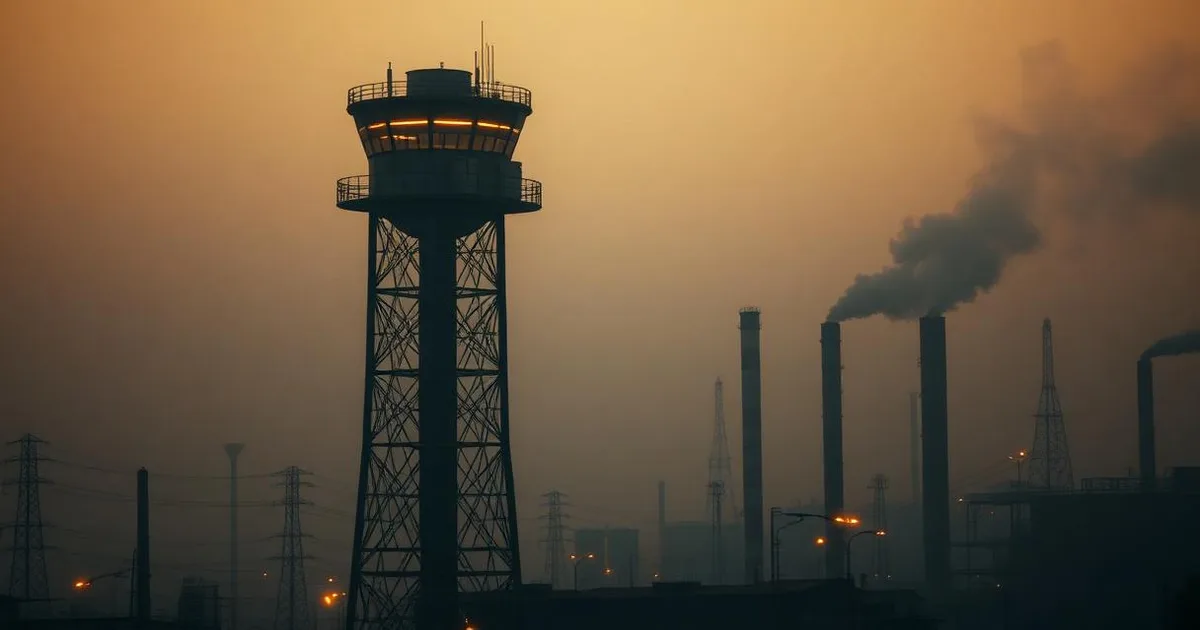
Few air quality technologies attract as much argument as the outdoor smog tower. Advocates present them as a visible response to unbreathable urban air; critics point out that no filtration system can meaningfully clean the atmosphere above a city, and that resources would be better spent on emission sources. Both positions contain something true, and the disagreement usually stems from a mismatch in expectations rather than in physics. A smog tower is a large-volume outdoor air treatment unit that reduces particulate concentration within a bounded zone around itself. Judged as a citywide intervention it fails; judged as engineered protection for a defined outdoor space where people are concentrated, it performs a task nothing else does. This article sets out the engineering honestly — how the technology works, what governs its effective radius, where deployment is justified, and how to specify one so it delivers what was promised.
How an Outdoor Smog Tower Works
The operating principle is deliberately simple, because outdoor equipment must survive weather, dust, and years of unattended operation. High-capacity fans draw polluted ambient air into the structure, typically through intakes distributed around the lower body. The air passes through a staged filtration train: coarse pre-filters remove leaves, insects, and large grit that would otherwise destroy fine media within weeks; intermediate filters capture the coarse particulate fraction and much of PM10; and high-efficiency final filtration removes the fine PM2.5 fraction that carries most of the health burden. Some configurations add activated carbon stages for gaseous pollutants and odour, or electrostatic sections to extend media life. Treated air is then discharged — usually upward and outward at velocity — to create a circulation pattern that draws further ambient air toward the intakes. Throughput is what distinguishes these units from indoor equipment: capacity is measured in hundreds of thousands of cubic metres per hour, because outdoor air volumes are unbounded and dilution works against you continuously.
The Physics That Sets the Limits
Understanding why smog towers cannot clean a city requires only a volume comparison. The urban boundary layer over a large city holds air volumes on a scale of cubic kilometres, replenished continuously by wind. Even a very large tower processes a tiny fraction of that per hour, and cleaned air mixes back into the surrounding atmosphere within a short distance. The honest statement is that outdoor filtration reduces concentration in a bounded zone whose extent is set by the tower's airflow, the discharge pattern, local wind speed, and the geometry of surrounding structures. In still, stable conditions — precisely the winter inversion conditions when urban particulate is worst — that zone is largest and the benefit most measurable, because there is less advective replacement of the treated volume. In windy conditions the effective zone shrinks sharply, though the ambient concentration is usually lower then too. Anyone claiming citywide effect is overselling; anyone claiming no effect at all is ignoring the measurements taken inside the treated zone.
Where Deployment Is Justified
The technology earns its place wherever people are concentrated outdoors in a defined area, or where a boundary needs a particulate buffer. Industrial plant boundaries are the clearest case: a tower positioned between a dusty operation and a residential edge reduces the concentration crossing that line, and does so visibly, which matters for community relations as well as compliance. Construction sites use them to control the fugitive dust that generates complaints and stop-work notices. Within campuses — schools, hospitals, corporate parks, and residential complexes — towers protect the specific outdoor spaces people actually occupy: entrance plazas, play areas, walkways, and waiting zones. Transport nodes such as bus terminals and station forecourts concentrate both pollution and dwelling pedestrians. Public spaces including parks and market squares are a valid application when the treated zone is placed where people gather rather than in the geometric centre of an empty lawn. In every one of these cases the intervention is bounded and the benefit is measurable, which is exactly the framing under which the technology should be sold and bought.
Siting: The Decision That Determines Performance
Two identical towers can differ by a wide margin in delivered benefit purely because of placement. Prevailing wind direction is the first consideration — a tower should sit upwind of the space being protected so that treated air is carried across it rather than away from it, using seasonal wind roses rather than a single day's observation. Proximity to the source matters next: intercepting dust near its origin, before it disperses, is dramatically more efficient than treating diluted air far downwind. Surrounding built form shapes the outcome, since buildings, walls, and dense tree lines create both sheltered pockets where treated air accumulates usefully and channelling effects that sweep it away. Discharge height and angle should be set so treated air passes through the breathing zone rather than over people's heads or straight into a wall. Practical constraints complete the picture: three-phase power availability, service vehicle access for filter changes, and a foundation adequate for wind loading on a tall structure. Site modelling before installation is inexpensive relative to the cost of relocating a commissioned tower.
Specifying the Right Unit
- Airflow capacity in cubic metres per hour, matched to the zone you intend to protect — the single most important number and the one most often quoted without context.
- Filtration stages and efficiency at PM2.5, with the sealing arrangement specified so that air cannot bypass the media around the frame.
- Pre-filtration robustness, because outdoor intake loading is orders of magnitude higher than indoor and undersized pre-filters translate directly into unaffordable fine-media consumption.
- Ingress protection and weather rating appropriate to monsoon exposure, ambient temperature extremes, and dust loading.
- Filter access and service interval — the total cost of ownership is dominated by media replacement and the labour to reach it.
- Integrated monitoring at intake and discharge, so that performance is evidenced continuously rather than asserted from a commissioning test.
- Power consumption at operating airflow, and whether variable-speed operation allows the unit to run harder during high-pollution hours and gentler otherwise.
Proving the Benefit
Because the effect is bounded, it must be measured to be credible — and this is where many deployments fail politically despite working technically. The correct approach is a paired-measurement design: monitors inside the intended protection zone and a reference monitor outside it but in comparable exposure, both logging continuously from before commissioning. The metric that matters is the difference between the two over time, not the absolute reading inside the zone, because absolute concentration will still rise and fall with regional pollution episodes. A tower can be working exactly as designed on a day when the reading inside the zone is high, if the reading outside is higher still. Presenting that comparison honestly — including the conditions under which the differential narrows — builds far more durable trust than a single favourable snapshot. Continuous air quality monitoring deployed alongside the tower turns this from an annual consultant exercise into a live dashboard.
Combining Outdoor and Indoor Treatment
Smog towers work best as one element of a layered strategy rather than a standalone answer. The logical sequence is: reduce emissions at source wherever it is technically possible, since nothing downstream is as efficient; treat the outdoor zones where people are concentrated with tower capacity; filter fresh-air intake so the building does not import what the tower just removed; and deploy indoor purification in occupied interiors where people spend the majority of their time. Each layer addresses a different exposure fraction, and monitoring across all of them shows which layer is limiting. Anytech Hughes outdoor smog towers are engineered for Indian ambient conditions — high dust loading, monsoon exposure, and sustained high-PM episodes — with staged filtration and integrated monitoring so that delivered performance is visible rather than assumed. Request a siting study and quote to size a deployment for your location.
Frequently Asked Questions
Do smog towers actually work?
They measurably reduce particulate concentration within a bounded zone around the unit. They do not clean a city's air — the atmospheric volume is far too large. Judged as protection for a defined outdoor area, they work; judged as a citywide solution, they do not.
What area does a smog tower cover?
The effective zone depends on airflow capacity, discharge design, wind conditions, and surrounding built form. It is largest in still, stable conditions and shrinks in wind, which is why siting studies matter more than headline capacity.
Where should a smog tower be installed?
Upwind of the space being protected, as close to the pollution source as practical, with discharge directed through the breathing zone, and with power and service access available. Prevailing seasonal wind direction should drive the decision.
How often do smog tower filters need replacement?
Pre-filters need frequent attention because outdoor dust loading is very high; fine filters last considerably longer if pre-filtration is properly sized. Differential pressure monitoring should drive the schedule rather than a fixed calendar.
Are smog towers better than indoor air purifiers?
They solve different problems. Towers treat bounded outdoor spaces; indoor purifiers treat the interiors where most people spend most of their time. A layered strategy uses both, alongside source reduction and filtered fresh-air intake.
Related Articles
Industrial Air Purifiers: A Complete Buyer's Guide
A practical specification guide for facility managers: how to size industrial air purifiers, read the numbers that matter, and avoid the traps in vendor datasheets.
Read moreIndoor vs Outdoor Air: Understanding the Difference
Why indoor air can be 2–5x more polluted than outdoor — and what that means for offices, hospitals, and homes.
Read moreCPCB and NBC Air Quality Norms: What Indian Facilities Must Know in 2026
India's air quality rules are spread across ambient standards, building codes, consent conditions, and monitoring mandates. Here is how they fit together for a facility team.
Read moreWant to discuss your specific requirements?
Our team can help assess and tailor a solution for your organization.
Request a Siting Study