
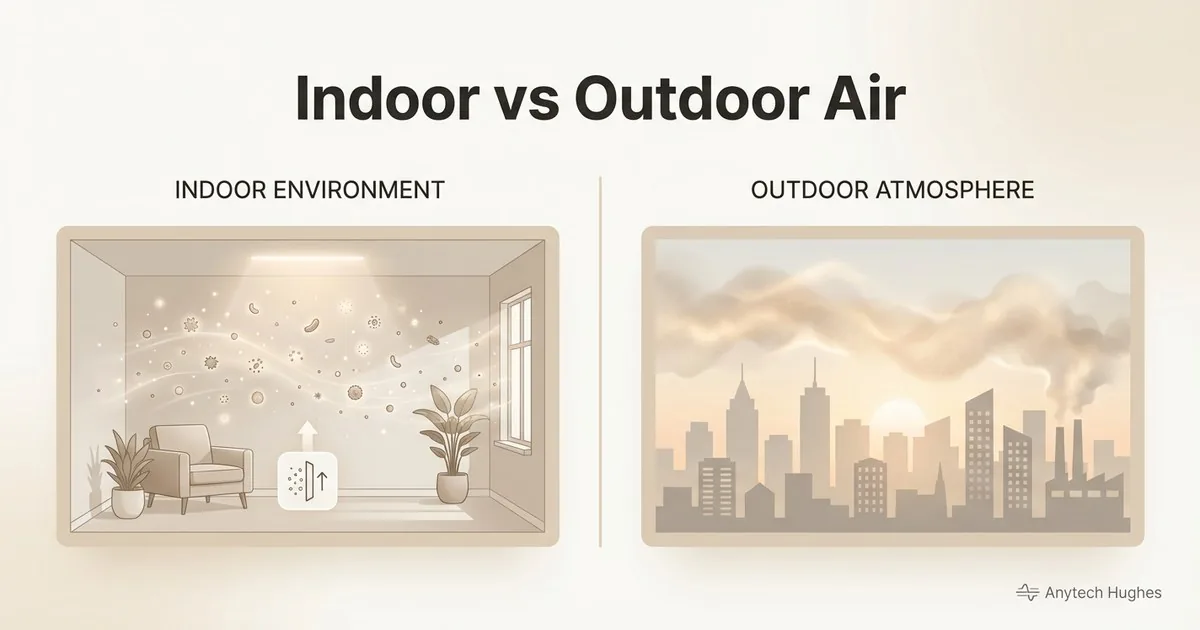
Most people assume that going indoors is the safest response to outdoor pollution — close the windows, and the problem stays out. The data tells a more nuanced story. The US EPA, WHO, and multiple independent studies have repeatedly found that indoor air is often two to five times more polluted than the air outside, and in poorly ventilated buildings the gap can be wider still. Given that the average urban professional spends roughly 90% of their time indoors — at home, in the office, in transit between sealed environments — indoor air quality, not outdoor, ends up being the dominant exposure for most people.
Why Indoor Air Is Often Worse
Indoor environments are pollutant accumulators. Cooking generates PM2.5 spikes that can exceed outdoor peaks, especially with frying and tadka-style cooking on gas stoves. Cleaning products, air fresheners, paints, adhesives, and new furniture continuously off-gas volatile organic compounds (VOCs) including formaldehyde and benzene. Laser printers and photocopiers release ultrafine particles. Human activity adds CO₂, bioaerosols, and skin/fabric particulate. HVAC systems often recirculate this loaded air rather than diluting it with fresh outdoor air, both for energy efficiency and — in polluted cities — to keep outdoor PM2.5 from coming in. The result is a cocktail of particulate, gas-phase, and biological pollutants that concentrates over the day and rarely gets fully cleared overnight, all of it invisible without instrumentation.
The Health Impact
Sustained exposure to elevated indoor PM2.5 and VOC levels is linked in peer-reviewed literature to chronic respiratory irritation, reduced lung function over time, headaches, fatigue, and elevated cardiovascular risk. Cognitive performance is the less-discussed casualty: Harvard's COGfx studies showed measurable drops in decision-making and information-usage scores when indoor CO₂ and VOCs rose, even at levels well below regulatory limits. In office settings this shows up as absenteeism, presenteeism, and lower productivity. In hospitals the stakes are higher — poor indoor air quality is directly associated with healthcare-associated infections, slower wound healing, and longer recovery times for immunocompromised patients. In schools, it correlates with attendance and test performance. The cost is rarely attributed to air quality because it's diffuse, but it's consistent.
What Effective Indoor Air Looks Like
A well-managed indoor environment is engineered, not improvised. It combines HEPA-grade filtration (H13 or H14) for particulate, a substantial activated carbon stage for VOCs and odors, and a defined air-changes-per-hour rate appropriate to the space — typically 4–5 ACH for general offices, 6+ for clinical waiting areas, 12+ for ICUs and operating theatres. It includes continuous monitoring so the system can be tuned and verified, not just installed and forgotten. And it accounts for occupancy patterns, since a meeting room full of people is a very different load than the same room empty. The mark of a well-managed system is not the spec sheet of the equipment but the consistency of the readings: indoor PM2.5 holding under 12 µg/m³ even when outdoor air sits in the 200s.
Designing for Your Space
Solutions for a 50-bed hospital are fundamentally different from those for a 50,000 sq.ft. corporate office, which are different again from a school, a hotel, or a manufacturing floor. The right approach starts with an on-site assessment: the actual room volumes including ceiling height, occupancy patterns through the day, the existing HVAC architecture, the building envelope and its leakage, and a baseline air-quality measurement to understand which pollutants are dominant. Only then does equipment selection and placement make sense. The most expensive mistake in this space is buying high-end purifiers without doing the sizing math first — and the most common is treating one corner unit as protection for an entire open-plan floor. Request a free assessment to get a sizing recommendation based on your actual volumes.
The Hidden Sources Most People Miss
Beyond the obvious — cooking, smoke, dust — most indoor environments host pollution sources that go unnoticed for years. Laser printers and photocopiers emit ultrafine particles every time they run. Scented candles and incense produce PM2.5 at concentrations that can rival vehicle exhaust. Gas hobs release nitrogen dioxide. Wall-to-wall carpet traps and re-releases dust, dust mites, and chemical residues. Newly painted rooms and freshly assembled furniture off-gas formaldehyde for weeks. Even houseplants, popular as 'natural air purifiers', do almost nothing for PM2.5 at the densities you'd realistically have indoors — the famous NASA study used sealed chambers with concentrations far below what a single small purifier would handle. Identifying and reducing source emissions is usually as important as filtration itself.
Ventilation vs Filtration: Knowing When to Use Which
These are two different problems with two different solutions. Ventilation — bringing in outdoor air — dilutes CO₂, VOCs, and bioaerosols that build up indoors. Filtration removes particulate and (with activated carbon) some gas-phase pollutants from the air already inside. ASHRAE 62.1 sets minimum ventilation rates for indoor spaces, and in clean-air geographies that's the right primary lever. In high-pollution geographies the equation flips: bringing in unfiltered outdoor air during a 300+ AQI day means importing the very pollutants you're trying to escape. The right answer is filtered ventilation — outdoor air drawn through HEPA + carbon stages before it enters the occupied space — combined with recirculating purifiers for the indoor load. Getting this balance right is the difference between a space that feels stuffy and a space that's both clean and breathable.
Related Articles
What is AQI and Why It Matters
Understanding the Air Quality Index — how it's measured, what the numbers mean, and why it should guide your decisions.
Read moreHow HEPA Filters Actually Work
The science behind HEPA — interception, impaction, diffusion — and why H13/H14 grades matter for indoor air quality.
Read moreChoosing the Right Air Purifier for Your Space
Sizing, ACH targets, filter stacks, and the most common mistakes — a practical guide for offices, clinics, and homes.
Read moreWant to discuss your specific requirements?
Our team can help assess and tailor a solution for your organization.
Request a Free Assessment