
HEPA — High Efficiency Particulate Air — is one of the most widely used and most misunderstood terms in air filtration. It isn't a brand, a coating, or a marketing badge; it's a performance standard backed by very specific physics. The label exists precisely because the underlying technology is unintuitive: HEPA filters are most efficient at the particle size most people would assume is the hardest to catch, and least efficient (relatively) at sizes both above and below it. Understanding why is the difference between specifying filtration that actually works and buying something that just sounds clinical.
Three Mechanisms, Not One
HEPA filters don't work like a sieve, which is the single most important thing to internalise about them. A sieve has holes; HEPA has a dense, randomised mat of borosilicate glass or polypropylene fibres with gaps far larger than many of the particles it catches. The capture happens through three simultaneous physical mechanisms. Interception: particles following an airflow streamline brush against a fibre and stick (van der Waals forces hold them there). Impaction: larger, heavier particles have too much inertia to follow the air's curving path around a fibre and slam into it instead. Diffusion: the very smallest particles get knocked around by collisions with air molecules — Brownian motion — and effectively wander into fibres by chance. Each mechanism dominates a different size range. The mathematical overlap of all three is least effective at one specific size: about 0.3 microns. That's why the HEPA standard is tested at exactly that size — it's the worst-case scenario.
Understanding the Grades
Under the EN 1822 standard used across Europe and India for serious filtration specification, true HEPA begins at H13, which captures at least 99.95% of particles at the most penetrating particle size (0.3 microns). H14 raises that to 99.995%. Above HEPA sit the ULPA grades (U15, U16, U17), used in semiconductor cleanrooms and pharmaceutical fill-finish lines, capturing 99.9995% and beyond. Below H13 are the EPA grades (E10, E11, E12) — efficient particulate air filters, sometimes confusingly marketed as HEPA-equivalent but not certified HEPA. The marketing terms 'HEPA-type', 'HEPA-style', 'HEPA-like', and '99% HEPA' are red flags: if a product can't cite its grade under EN 1822 or the equivalent IEST standard, it isn't certified, and its performance in your space is unverifiable. For hospitals, laboratories, semiconductor environments, and serious enterprise deployments, the certified grade is the spec that matters.
Why HEPA Alone Isn't Enough
HEPA captures particles. It does almost nothing for gases. Volatile organic compounds (VOCs) from paints, adhesives, cleaning products, fragrances, and new furniture; odors from cooking, bathrooms, and crowds; gas-phase combustion products like nitrogen dioxide and sulphur dioxide; and a significant fraction of smoke pass straight through a HEPA filter. That's why serious indoor air systems pair HEPA with a substantial activated carbon stage. Activated carbon works by adsorption — gas molecules physically bind to the enormous internal surface area of the carbon (a single gram can have several hundred square metres of surface area). The amount of carbon matters: a few hundred grams in a domestic unit will reach saturation quickly, while several kilograms in an enterprise-grade unit can stay effective for months. For specific gas-phase pollutants like formaldehyde, additional impregnated media (potassium permanganate or other oxidisers) are added to handle what plain carbon catches less efficiently.
Lifespan and Maintenance
HEPA filters don't fail in the way most components do — they don't tear, leak, or stop catching particles. They fail by loading: as more particulate accumulates in the fibre mat, pressure drop across the filter rises, the fan has to work harder, airflow through the unit drops, and the effective clean air delivery into the room collapses even though the filter itself is technically still 'working'. In a moderately polluted office environment, indoor HEPA units typically warrant filter replacement every 12–24 months; in a high-pollution residential or industrial setting, that interval can be six months or less. Pre-filters (capturing the largest particles) should be cleaned or swapped more often to extend HEPA life. The carbon stage saturates on its own timeline, usually shorter than the HEPA, especially in spaces with heavy VOC sources. The discipline of scheduled replacement, ideally informed by monitoring data and pressure-drop indicators, is what separates filtration that delivers on the spec sheet from filtration that becomes a placebo within a year.
MPPS — The 0.3 Micron Myth
A common misconception is that HEPA filters can catch particles down to 0.3 microns and nothing smaller. The reality is the opposite: 0.3 microns is the Most Penetrating Particle Size (MPPS), and HEPA filters are actually more efficient above and below it. Larger particles get caught easily by impaction and interception. Smaller particles, including viruses (which are typically 0.02–0.3 microns) and ultrafine combustion particles, get caught even more efficiently by diffusion — their Brownian motion essentially guarantees they collide with a fibre. This is why HEPA is used in BSL-3 and BSL-4 biocontainment laboratories handling sub-micron pathogens, and why COVID-era studies confirmed HEPA's effectiveness against airborne SARS-CoV-2 despite the virus being smaller than the 0.3 micron rating point. The standard tests at MPPS precisely because passing the worst-case test guarantees performance everywhere else.
ULPA, ePM, ISO 16890 — The Other Standards You'll See
Beyond HEPA grades you'll encounter several adjacent standards in technical specifications. ULPA (Ultra Low Penetration Air) covers grades U15 to U17 under EN 1822, used where even HEPA isn't sufficient — typically semiconductor manufacturing, sterile pharmaceutical production, and the highest-grade medical isolation environments. ISO 16890 is the modern replacement for the older MERV/EN 779 ratings and classifies coarser filters by what fraction of PM10, PM2.5, and PM1 they capture (ePM10, ePM2.5, ePM1 ratings) — useful for HVAC pre-filters and supply-air filtration. MERV (Minimum Efficiency Reporting Value) is the parallel North American standard, with MERV 13 and above offering meaningful PM2.5 capture but still well below true HEPA performance. The takeaway when reading a spec: confirm which standard the rating is given under, because a filter rated under one scheme isn't directly comparable to one rated under another.
Related Articles
PM2.5 vs PM10: What's the Difference?
The two particle sizes that dominate air quality reporting — what they are, how deep they penetrate, and which one matters more.
Read moreChoosing the Right Air Purifier for Your Space
Sizing, ACH targets, filter stacks, and the most common mistakes — a practical guide for offices, clinics, and homes.
Read moreIndoor vs Outdoor Air: Understanding the Difference
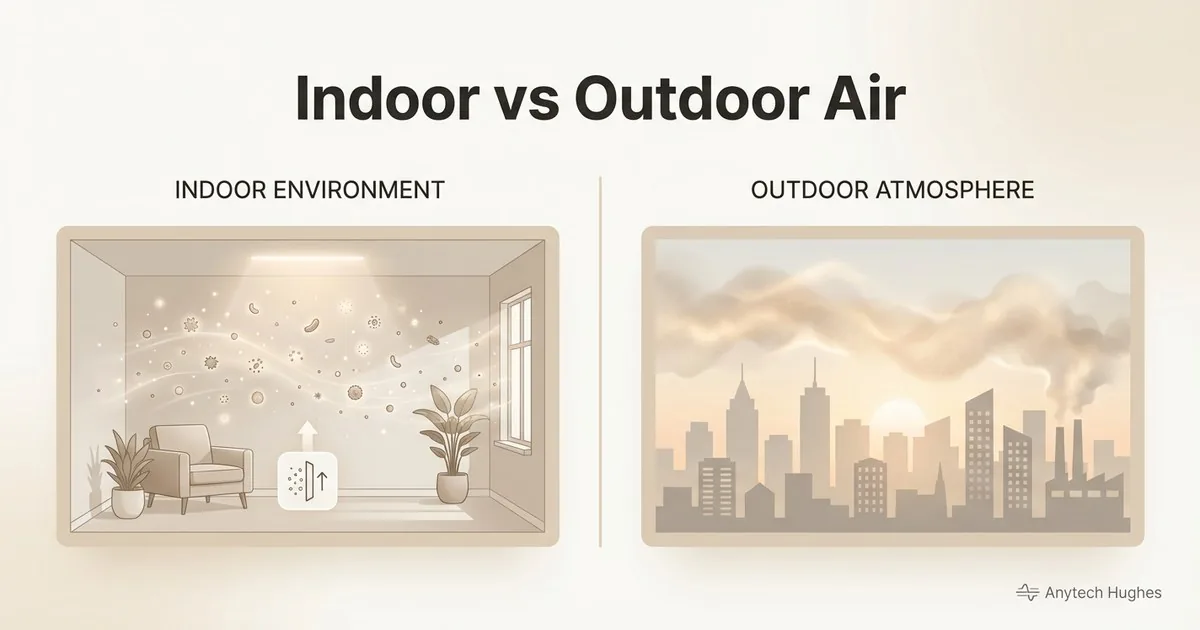
Why indoor air can be 2–5x more polluted than outdoor — and what that means for offices, hospitals, and homes.
Read moreWant to discuss your specific requirements?
Our team can help assess and tailor a solution for your organization.
See Our Filtration Stack