
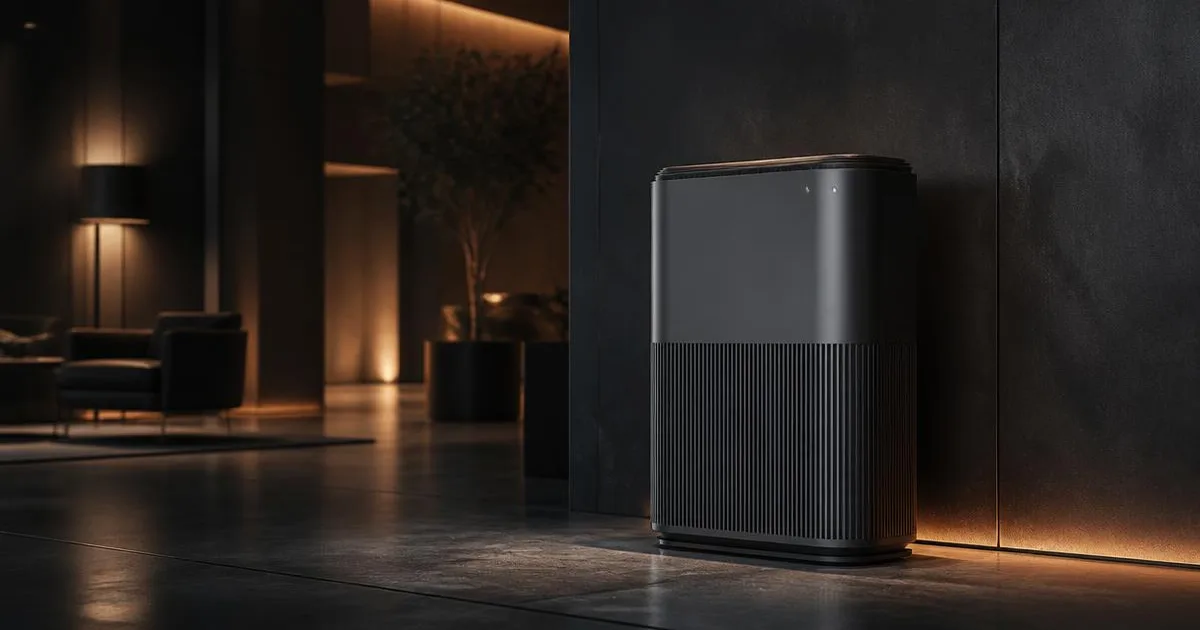
Buying an industrial air purifier is not like buying a consumer appliance. The unit has to move large volumes of air through dense filtration media, run for long hours without disturbing the people around it, survive years of Indian ambient dust loading, and justify its cost against a maintenance budget that is already stretched. Yet most purchase decisions are still made from a single number on a brochure — coverage area in square feet — which is the least reliable figure a vendor can print. This guide walks through what actually determines performance in a commercial or industrial deployment, how to read the specifications that matter, and how to build a comparison that survives scrutiny from both the engineering team and the finance team.
Start With the Contaminant, Not the Machine
Before comparing products, define what you are removing. Particulate matter — PM2.5, PM10, and finer ultrafine fractions — is the dominant concern in most Indian urban and industrial settings, and it is addressed by mechanical filtration. Gases and odours are a different problem entirely: volatile organic compounds from furniture, solvents, printing, or process emissions pass straight through a particle filter and require adsorption media. Biological contaminants such as bacteria, fungal spores, and virus-carrying aerosols behave like particles physically but carry infection-control implications that change the standard you must meet. Many facilities need all three addressed, but the weighting differs. A machining shop is a particulate problem with an oil-mist component. A hospital ward is a particulate and biological problem with strict air-change requirements. A corporate office in Delhi NCR is predominantly a PM2.5 problem with a secondary CO₂ and VOC component. Once the contaminant profile is written down, half the product shortlist usually eliminates itself. If you are unsure where to start, the difference between PM2.5 and PM10 is a useful primer.
Clean Air Delivery Rate: The Number That Matters
Coverage area claims are derived numbers; Clean Air Delivery Rate (CADR) is a measured one. CADR expresses how much genuinely filtered air a unit delivers per hour, and it accounts for both fan capacity and filter efficiency together. A purifier with a powerful fan and a weak filter and a purifier with a strong filter and an underpowered fan can both quote impressive-sounding figures, but their CADR tells the truth. To convert CADR into a room specification, decide how many air changes per hour (ACH) the space needs, multiply room volume by that ACH, and match the result against CADR. Two air changes per hour is a minimum for general comfort; four to five is appropriate for offices in high-pollution cities; six or more is expected in clinical and high-occupancy settings. Note that CADR is measured under laboratory conditions with a clean filter — real-world delivery falls as filters load, ducted installations add pressure drop, and furniture disrupts airflow. A sensible engineering margin is 20 to 30% above the calculated requirement.
Filtration Stages and What Each One Buys You
A credible industrial unit uses staged filtration rather than a single element. A washable pre-filter captures hair, lint, and coarse dust, protecting the expensive media behind it and extending service life considerably — in high-dust Indian environments this stage alone can double HEPA life. A medium-efficiency stage handles the intermediate particle range. The HEPA stage does the critical work: H13-grade media captures 99.95% of particles at the most penetrating size, and H14 reaches 99.995%, with 99.97% at 0.3 microns being the widely quoted benchmark. An activated carbon bed follows for gases and odours; the important specification here is carbon weight in kilograms, not the presence of a thin carbon-impregnated sheet, because adsorption capacity scales with mass. Some units add UV-C or photocatalytic stages for microbial inactivation. Each stage adds pressure drop, so the fan must be specified around the full assembled stack rather than around any single filter. Comparing HEPA, activated carbon, and ionizers covers the trade-offs between technologies in more depth.
Noise, Placement, and Occupant Acceptance
The most common cause of a failed air-purification deployment is not technical — it is that occupants turn the machines down or off. Noise is the usual culprit. A unit that is inaudible at low speed but roars at the setting required to hit design airflow will be run at low speed permanently, and the specified CADR becomes fiction. Target sub-45 dB operation at the speed you actually intend to run, and ask vendors to state the noise level at that airflow rather than at minimum. Placement matters just as much: units need clear intake and discharge paths, should not be tucked behind furniture or into corners, and should be positioned to establish circulation across the occupied zone rather than short-circuiting air from outlet straight back to inlet. In large open-plan spaces, several medium units distributed across the floor plate almost always outperform one large unit in a corner, even when total CADR is identical.
Build Quality, Serviceability, and Filter Supply
Industrial duty means metal housings, sealed filter frames, and gasketing that prevents bypass leakage around the media — an unsealed HEPA in a leaky housing can deliver a fraction of its rated efficiency because air takes the path of least resistance. Check that filters can be changed by facility staff without special tools, that filter orientation is unambiguous, and that a differential-pressure indicator or filter-life monitor tells you when replacement is genuinely due rather than on a fixed calendar. Filter availability is a commercial risk that is easy to overlook at purchase: confirm lead times, local stock, and pricing for replacement media before signing, and be cautious of proprietary cartridge designs with a single supply channel. A machine that cannot be re-mediated within a week of a filter failing is a machine that will sit idle.
Energy Consumption and Total Cost of Ownership
Purchase price is typically a minority of lifetime cost. Build a five-year model that includes capital cost, electricity at the duty cycle you expect, replacement filter sets at their real intervals, and labour for servicing. Units running twelve hours a day, six days a week accumulate meaningful energy cost, so fan efficiency and the availability of automatic sensor-driven speed control have real financial value — a unit that idles at low power when air quality is good and ramps only when needed can cut energy consumption substantially without any loss in protection. Filter economics are the other large variable: a cheaper machine with short-life, high-cost filters frequently overtakes a more expensive machine with durable, sensibly priced media inside two years. Present the comparison as cost per cubic metre of clean air delivered over five years, and the right answer usually becomes obvious to both engineering and procurement.
Monitoring, Verification, and Proving the Investment
An air purifier without measurement is an act of faith. Deploy calibrated monitoring alongside the units so that before-and-after PM2.5, CO₂, and VOC data exist for the same spaces. This serves three purposes: it validates that the sizing was correct, it identifies zones that need additional capacity, and it gives leadership a defensible number for the health and productivity case. Continuous monitoring also catches silent failures — a blocked filter, a unit switched off, a door propped open — that periodic spot checks miss entirely. For campuses, hospitals, and multi-floor offices, a networked air quality monitoring system that logs and dashboards this data is the difference between managing air quality and hoping for it. Continuous monitoring and compliance explains why sampled readings systematically mislead.
A Practical Evaluation Checklist
- Written contaminant profile: particulate, gaseous, biological, or a combination.
- Required ACH for each space type, converted to a target CADR with a 20–30% margin.
- Filtration stack specified stage by stage, including HEPA grade (H13/H14) and carbon weight in kilograms.
- Noise level quoted at design airflow, not at minimum speed — target under 45 dB in occupied areas.
- Sealed housing, tool-free filter access, and a filter-life or differential-pressure indicator.
- Confirmed replacement filter pricing, lead time, and local availability.
- Five-year total cost of ownership, expressed per unit of clean air delivered.
- Monitoring plan with baseline data captured before installation.
Where Anytech Hughes Fits
Anytech Hughes supplies indoor air purification systems built around H13/H14 HEPA media with 99.97% particle capture, coverage configurations extending to 5,000+ sq. ft., and whisper-quiet operation below 45 dB so that units are actually left running. For ambient and perimeter applications, outdoor smog towers address open and semi-open environments, and our monitoring systems close the loop with continuous verification. Because sizing is site-specific, we work from a survey of your floor plan, occupancy pattern, and measured baseline readings rather than a catalogue lookup. Request a site assessment to get a sized recommendation with the supporting calculations attached.
Frequently Asked Questions
How do I size an industrial air purifier for my space?
Multiply room volume by the target air changes per hour, then match that figure against the unit's Clean Air Delivery Rate, adding a 20–30% margin for filter loading and real-world airflow obstruction.
Is coverage area in square feet a reliable specification?
No. Coverage claims assume a fixed ceiling height and a low air-change rate. CADR combined with your required air changes per hour is the reliable basis for sizing.
What HEPA grade should a commercial purifier use?
H13 captures 99.95% of the most penetrating particle size and H14 reaches 99.995%; 99.97% capture at 0.3 microns is the common benchmark for commercial and clinical use.
How loud should an office air purifier be?
Below 45 dB at the speed you intend to run continuously. Units that are only quiet at minimum speed get turned down and never deliver their rated performance.
What drives the total cost of owning an air purifier?
Replacement filters and electricity usually exceed the purchase price over five years, so filter life, filter pricing, and fan efficiency matter more than the initial quotation.
Related Articles
HEPA vs. Activated Carbon vs. Ionizers: Which Is Right for You?
Three technologies, three completely different jobs. Understanding what HEPA, carbon, and ionizers each physically do is the fastest way to avoid buying the wrong system.
Read moreProtecting Employees: Air Quality in Large Corporate Offices
Indoor air is one of the few workplace variables that affects health, cognition, and retention simultaneously — and one of the easiest to measure and fix.
Read moreIndoor Air Quality Standards for Indian Hospitals & Healthcare
Air quality in a hospital is a clinical parameter, not a comfort setting. Here is how Indian healthcare facilities should specify, operate, and verify it.
Read moreWant to discuss your specific requirements?
Our team can help assess and tailor a solution for your organization.
Request a Sizing Assessment