
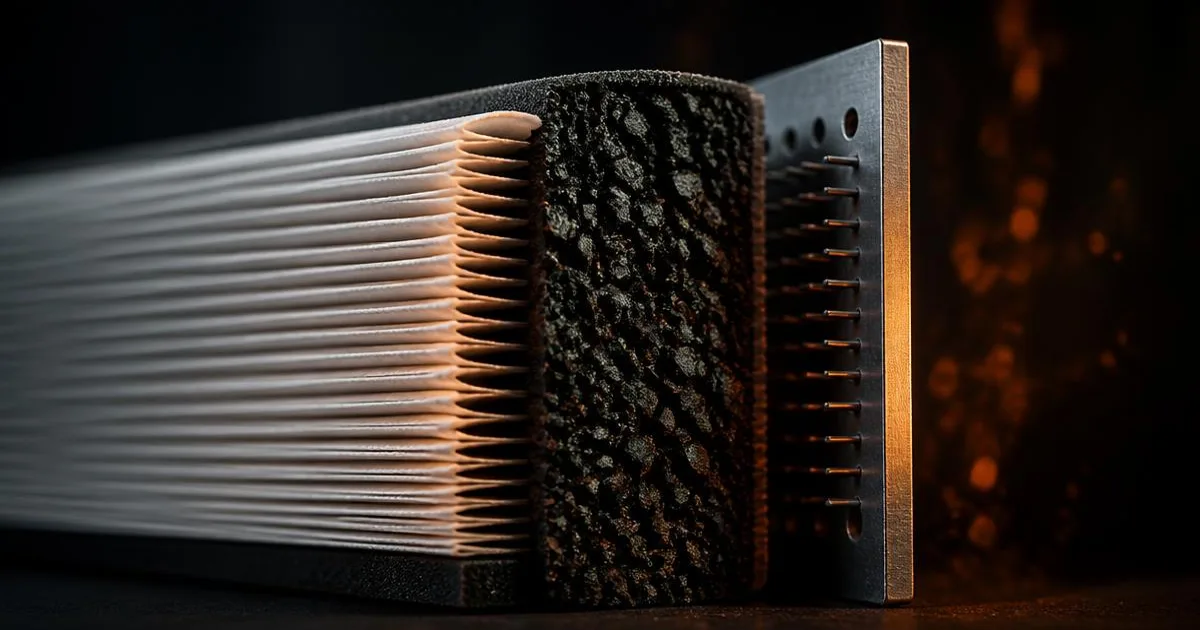
Air purifier marketing tends to present HEPA filters, activated carbon, and ionizers as competing options — as though a buyer must pick a side. Physically, they are not alternatives at all. They act on different contaminants through different mechanisms, and two of them are complementary while the third carries trade-offs that many buyers only discover after installation. This article explains what each technology actually does, the evidence behind its performance claims, where each one fails, and how to assemble a system that matches the contaminants present in your building rather than the ones in a brochure.
HEPA: Mechanical Capture of Particles
A High Efficiency Particulate Air filter is a dense mat of randomly arranged glass or synthetic fibres that physically traps particles. It works through four mechanisms operating simultaneously: interception, where a particle following an air streamline touches a fibre; impaction, where a heavier particle's momentum carries it into a fibre rather than around it; diffusion, where very small particles move erratically through Brownian motion and collide with fibres; and, to a lesser degree, electrostatic attraction. Because impaction dominates for large particles and diffusion dominates for very small ones, efficiency is lowest in the middle — around 0.1 to 0.3 microns, the Most Penetrating Particle Size. That is precisely why HEPA ratings are quoted at 0.3 microns: it is the hardest case, not a convenient one. Certified H13 media captures 99.95% at that size and H14 captures 99.995%, with 99.97% capture the widely used commercial benchmark. Counter-intuitively, particles smaller than 0.3 microns are captured more efficiently, not less. How HEPA filters actually work covers the physics in more detail.
Where HEPA Falls Short
HEPA media is a particle technology and nothing more. Gas molecules — formaldehyde, benzene, ammonia, sulphur dioxide, the volatile compounds released by new furniture and cleaning agents — are orders of magnitude smaller than the fibre spacing and pass through untouched. HEPA also imposes pressure drop, which means a fan capable of pushing air through dense media; underpowered units paired with HEPA cartridges deliver disappointing clean-air rates regardless of the filter's rating. Efficiency claims are also only valid if the filter is properly sealed into its housing, since unsealed frames allow air to bypass the media entirely. Finally, HEPA is a consumable: it loads over time, pressure drop rises, and airflow falls. In high-dust Indian environments, a washable pre-filter ahead of the HEPA stage is not optional if you want reasonable service intervals.
Activated Carbon: Adsorption of Gases and Odours
Activated carbon works by adsorption rather than filtration. Carbon is processed to create an enormous internal surface area — a single gram can present hundreds of square metres of pore surface — and gas molecules adhere to those surfaces through weak intermolecular forces. This is what removes VOCs, cooking and washroom odours, solvent fumes, and many traffic-related gases that a HEPA filter cannot touch. Performance is driven by three variables: the mass of carbon present, the contact time between air and the carbon bed, and any chemical impregnation used to target specific gases such as ammonia or formaldehyde. This is where marketing diverges sharply from engineering. A carbon-impregnated sheet weighing a few dozen grams will show measurable removal in a short test and then saturate within weeks. A genuine carbon bed carries kilograms of granular media and provides months of useful capacity. When comparing products, ask for carbon weight in kilograms; if a vendor will not state it, that is itself the answer.
The Saturation Problem
Adsorption is reversible. As a carbon bed approaches saturation, it stops capturing new molecules, and under rising temperature or changing humidity it can begin releasing previously captured compounds back into the airstream — the reason a neglected purifier sometimes smells worse than the room it is treating. Carbon therefore requires a replacement discipline based on exposure rather than a fixed calendar: a bed in a printing facility or laboratory saturates far faster than one in a low-VOC office. Any specification that includes carbon should include a stated replacement interval for the actual application, and the maintenance budget should reflect it. Carbon is also a poor choice as a standalone technology in dusty environments, because particulate loading blinds the pore structure and destroys adsorption capacity long before the carbon itself is exhausted — which is why carbon almost always sits downstream of particle filtration.
Ionizers and Electrostatic Devices
Ionizers take a different approach: rather than capturing particles in media, they emit charged ions that attach to airborne particles, causing them to clump together and settle onto surfaces or, in electrostatic precipitator designs, onto oppositely charged collector plates. The appeal is low pressure drop, quiet operation, and washable collector plates instead of consumable filters. The concerns are equally real. Particles that settle rather than being captured are removed from the air but remain in the room, where activity can resuspend them. Collection efficiency drops markedly as plates load with dust, so performance degrades between cleanings in a way that is invisible to occupants. Most importantly, ion-generating and corona-discharge devices can produce ozone as a byproduct — a respiratory irritant and a regulated pollutant. Any ionizing device specified for an occupied space should carry independent certification of ozone emission below recognised safety thresholds. In clinical and high-occupancy environments where verified capture is required, ionization should not be relied on as the primary removal mechanism.
UV-C and Photocatalytic Stages
Two supplementary technologies frequently appear alongside the main three. UV-C germicidal irradiation inactivates bacteria, fungi, and viruses by damaging their nucleic acids, but effectiveness depends entirely on dose — the product of lamp intensity and exposure time. Air moving quickly past a low-output lamp receives too little dose to matter, so UV-C is most credible in in-duct configurations with adequate residence time, and in coil-irradiation applications that keep cooling coils free of microbial growth. Photocatalytic oxidation uses UV light on a titanium-dioxide surface to break down organic molecules; it can be effective, but incomplete oxidation can generate intermediate byproducts including formaldehyde, so it needs careful validation. Neither technology substitutes for mechanical particle capture. Both should be assessed as additions to a properly specified HEPA and carbon stack, not as replacements for it.
Choosing the Right Combination
The correct answer for most commercial and industrial buildings is a staged system: pre-filter for coarse dust, H13 or H14 HEPA for fine particulate including PM2.5, and a substantial granular carbon bed for gases and odours, with UV-C added where infection control justifies it. Ionization has a defensible role in specific ambient and industrial contexts where pressure drop must stay minimal and ozone emissions are independently verified, but it should complement rather than replace mechanical capture in occupied indoor spaces. The weighting between stages follows the contaminant profile: a Delhi NCR office weights HEPA capacity heavily, a laboratory or print facility weights carbon mass heavily, and a hospital weights HEPA grade, sealing integrity, and air-change rate above everything else. Anytech Hughes indoor purification systems are built on the HEPA-plus-carbon architecture with H13/H14 media at 99.97% capture and sub-45 dB operation, so protection is delivered without the noise penalty that leads occupants to switch units off.
Frequently Asked Questions
Is HEPA better than activated carbon?
They address different contaminants. HEPA captures particles including PM2.5; activated carbon adsorbs gases and odours. Most buildings need both, staged in sequence.
Are ionizers safe to use indoors?
Ion-generating devices can produce ozone, a respiratory irritant. Only use units with independent certification of ozone emission below recognised safety limits, and avoid relying on them as the sole removal mechanism in clinical settings.
How often should activated carbon be replaced?
It depends on gas loading, not the calendar. High-VOC environments such as laboratories and print facilities saturate carbon far faster than low-VOC offices, so replacement intervals should be set per application.
Does HEPA remove viruses?
HEPA captures virus-carrying aerosol particles very effectively, including at sizes below 0.3 microns where diffusion capture dominates. It does not inactivate pathogens, but it removes the particles carrying them.
Do I need UV-C in an air purifier?
UV-C is worth adding where infection control is a priority and the design provides adequate exposure dose. It is a supplement to mechanical filtration, never a replacement for it.
Related Articles
How HEPA Filters Actually Work
The science behind HEPA — interception, impaction, diffusion — and why H13/H14 grades matter for indoor air quality.
Read moreIndustrial Air Purifiers: A Complete Buyer's Guide
A practical specification guide for facility managers: how to size industrial air purifiers, read the numbers that matter, and avoid the traps in vendor datasheets.
Read moreIndoor Air Quality Standards for Indian Hospitals & Healthcare
Air quality in a hospital is a clinical parameter, not a comfort setting. Here is how Indian healthcare facilities should specify, operate, and verify it.
Read moreWant to discuss your specific requirements?
Our team can help assess and tailor a solution for your organization.
Talk to an Air Quality Specialist