
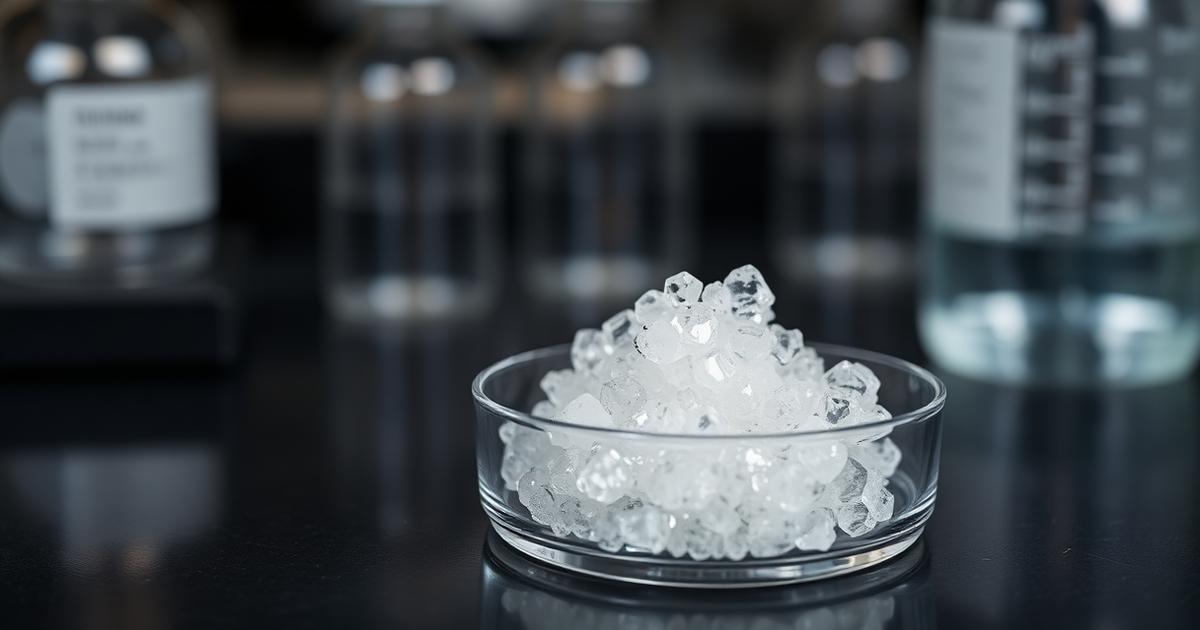
Potassium chloride (KCl) is one of the most widely used fertilizer raw materials in the world. It is also a chemical feedstock for glass, pharmaceuticals, food processing, and numerous industrial applications. India imports the majority of its KCl requirement, making domestic supply both strategically valuable and economically attractive. The unlikely feedstock for that domestic supply is cement bypass dust — the same hazardous byproduct that cement plants currently pay to dispose of. The Anytech Hughes Chlorine Bypass System converts this dust into KCl at ≥ 99% purity through a controlled sequence of leaching, separation, crystallisation, and residue recovery. This article explains the chemistry and the commercial logic behind that conversion.
The Chemistry of Bypass Dust
Bypass dust is a concentrated cocktail of the volatile compounds that circulate inside a cement kiln. Its dominant soluble salts are potassium chloride (KCl) and sodium chloride (NaCl), with smaller amounts of sulphates and carbonates. It also carries calcium compounds, unreacted raw meal, and trace heavy metals such as lead, cadmium, and chromium that vaporise in the high-temperature burning zone and condense on the dust particles. The first insight behind circular processing is that the chlorides are not contaminants to be destroyed; they are valuable chemicals that happen to be mixed with other materials. The second insight is that the heavy metals, while problematic in the mixed dust, can be separated and immobilised with the right process conditions. The challenge is therefore separation and purification, not disposal.
Leaching and Crystallisation
The core of the Anytech Hughes process is selective leaching. The bypass dust is mixed with water under controlled temperature and pH conditions that dissolve the soluble alkali chlorides while leaving most of the calcium-rich solids in a filterable form. The resulting brine contains potassium and sodium chlorides in solution, along with dissolved heavy metals. A series of precipitation and separation steps removes the heavy metals to very low levels — up to 99.9% removal has been demonstrated — and adjusts the ionic balance so that potassium chloride can be crystallised preferentially. Crystallisation is driven by controlled cooling and evaporation, producing solid KCl crystals that are then washed, dried, and sized. The mother liquor remaining after crystallisation is recycled within the process where possible, minimising liquid effluent.
Achieving ≥ 99% Purity
Purity is what determines whether recovered KCl can be sold into premium markets or only low-value outlets. Fertilizer-grade muriate of potash (MOP) typically requires KCl purity above 98%, with tight limits on sodium, magnesium, calcium, and moisture. Industrial and specialty applications can demand even higher specifications. The Anytech Hughes process is designed to yield KCl at ≥ 99% purity, meeting both fertilizer and many industrial grades. This is achieved through a combination of selective crystallisation, counter-current washing of the crystals, and final drying to the required moisture content. The result is a white crystalline product that is chemically equivalent to conventionally mined potash, produced on-site from a material the plant would otherwise have paid to landfill.
Uses of Recovered KCl
Recovered KCl from bypass dust can enter several value chains. The largest by volume is fertilizer manufacturing, where it is blended into NPK fertilizers or sold straight as MOP. Potassium is an essential plant nutrient, and Indian agriculture consumes millions of tonnes of KCl equivalent each year. Beyond fertilizer, KCl is used as a raw material in the production of potassium hydroxide, potassium carbonate, and other potassium chemicals; in water softening; in food processing as a salt substitute and firming agent; and in pharmaceutical and laboratory applications. The exact market depends on the plant's location, logistics, and offtake partnerships, but the breadth of uses means most producers can find a buyer within a reasonable radius, especially in India's densely industrialised corridors.
Economics of On-Site Recovery
The economic attractiveness of KCl recovery depends on four variables: the annual bypass dust volume, the chloride content of that dust, the local market price for KCl or MOP, and the avoided landfill cost. A plant producing 15,000 tonnes of bypass dust per year with a typical chloride content can recover a meaningful tonnenage of KCl, turning a disposal cost into product revenue. When the avoided landfill, transport, and compliance costs are added, the total benefit can reduce dust-related operating costs by around 40%. The payback period depends on capex and offtake terms, but for mid-sized and large integrated plants the project economics are typically compelling. Smaller plants may choose to partner in a hub model or integrate with a neighbouring facility to reach viable scale. Contact our team for a preliminary economic assessment based on your plant's dust profile.
Integration with Cement Operations
A critical requirement for any circular technology in cement is that it must not disrupt clinker production. The Anytech Hughes CCU & CCS systems is designed as a modular add-on: bypass dust is collected as usual, then routed to the processing unit; the cleaned residual material is returned to the raw meal or kiln feed; and the KCl product is packaged and dispatched. Because the chlorine has already been removed from the residual, it can be reintroduced without the chemistry problems that made the original dust a disposal issue. The process shares utilities and control systems with the main plant where practical, but operates as a distinct train with its own quality checks. This modular approach means the plant can commission, test, and ramp the system without taking the main kiln offline.
Quality Assurance and Market Acceptance
Recovered KCl must meet market specifications before it can be sold. The first gate is chemical purity: fertilizer buyers typically require KCl content above 98%, with controlled limits on sodium, magnesium, calcium, and moisture. The ≥ 99% purity target set by the Anytech Hughes process comfortably clears this bar. The second gate is consistency: every batch should fall within a narrow specification band, because off-spec material is either rejected or heavily discounted. The third gate is documentation: buyers want certificates of analysis, traceability to the production batch, and evidence that heavy metals have been removed to safe levels. Achieving this requires a quality-control programme built into the process — online sensors, laboratory sampling, batch records, and calibration routines. Market acceptance is therefore not a marketing problem; it is an operations problem. Plants that run the process with discipline find that recovered KCl is accepted on the same terms as imported potash, which is the point at which the circular loop becomes financially self-sustaining.
Economics of KCl Recovery
The financial model for KCl recovery has three main revenue and cost-avoidance streams. The first is avoided disposal cost: every tonne of bypass dust processed is a tonne that does not need to be bagged, transported, and landfilled. At current Indian hazardous-waste disposal rates, this saving alone is material for plants producing thousands of tonnes per year. The second is product revenue: recovered KCl can be sold into fertiliser, industrial, or export markets, with pricing broadly linked to international potash benchmarks. The third is raw-material displacement: the cleaned calcium-rich residue can partially replace purchased raw materials in the cement kiln, reducing both cost and quarrying impact. Against these benefits must be set the capital cost of the processing plant, operating chemicals and energy, labour, maintenance, and offtake logistics. The Anytech Hughes system is designed to keep operating costs low through efficient leaching, energy recovery, and modular scaling. A typical commercial unit processing 10,000–20,000 tonnes of dust per year can recover several thousand tonnes of KCl annually, which is enough to materially improve the plant's waste-management economics.
Frequently Asked Questions
What is potassium chloride used for?
KCl is mainly used as a fertilizer (muriate of potash) and as a feedstock for industrial potassium chemicals, water treatment, food processing, and pharmaceuticals.
How is KCl recovered from bypass dust?
The dust is leached to dissolve alkali chlorides, heavy metals are separated, and the brine is crystallised to produce solid KCl crystals of ≥ 99% purity.
What happens to the leftover residue?
After chloride and heavy-metal removal, the calcium-rich residue can be returned to the cement kiln as a raw material substitute.
Can the process handle varying dust compositions?
Yes. The process is designed to accommodate the normal variation in chloride, alkali, and heavy-metal content across different bypass dust streams.
Is recovered KCl as good as mined potash?
The Anytech Hughes process produces KCl at ≥ 99% purity, equivalent to fertilizer-grade and many industrial-grade potash products.
Related Articles
What is a Chlorine Bypass System (CCU & CCS) in Cement Plants?
A technical introduction to Chlorine Bypass Systems: why cement kilns need them, how they work, and how they turn a hazardous waste stream into value.
Read moreUnderstanding Cement Bypass Dust (CBD): Challenges and Opportunities
Why cement bypass dust is hazardous, why disposal is getting harder, and how circular processing turns the problem into an opportunity.
Read moreCircular Economy in the Cement Industry: Turning Waste into Value
How circular economy principles apply to cement manufacturing — and how CCU & CCS technology turns waste streams into revenue streams.
Read moreWant to discuss your specific requirements?
Our team can help assess and tailor a solution for your organization.
Explore Carbon Capture