
One platform. Three commercial feedstock routes.
Mineral carbonation reacts flue-gas CO₂ with alkaline waste already present on your site. The carbon is locked permanently into a solid, and what was a disposal cost leaves the plant as a saleable product.
The raw materials are already inside the plant.
CBS dust, coal fly ash and steel slag supply the reactive mineral phase. Industrial flue gas supplies the CO₂ directly, without upstream enrichment.
Cement bypass dust
- Source
- Chlorine Bypass System, cement kiln
- Composition
- High CaO. Rich in potassium and chlorine.
- Today
- Landfilled, or carries a disposal cost
- Role in the process
- Feedstock for potassium chloride recovery
Fly ash
- Source
- Coal-fired power stations and refineries
- Composition
- CaO, MgO, SiO2, Al2O3
- Today
- Stockpiled in large volumes at near-zero cost
- Role in the process
- Skeleton material for bricks and building products
Steel slag
- Source
- Iron and steel production
- Composition
- Free CaO and Ca(OH)₂
- Today
- Stockpiled or used in constrained applications
- Role in the process
- Feedstock for carbonated aggregate and construction materials
Flue-gas CO₂
- Source
- Cement, steel, power and refinery stacks
- Composition
- Site-specific CO₂ concentration and impurities
- Today
- Vented to atmosphere
- Role in the process
- Carbonation agent — supplied on site, no purchase required
Waste with a disposal cost becomes raw material at near-zero purchase cost. That is where the economics of CCU begin.
Cement bypass dust to high-purity potassium chloride.
Cement kilns burning alternative fuels accumulate chlorine. The Chlorine Bypass System strips it out and produces a chloride-rich dust that is currently a regulated waste. That dust is our feedstock.
- Chlorine accumulation
- Above 0.5% in the kiln, chlorine causes preheater build-up, coating and blockages.
- Regulated waste
- Bypass dust is costly to store, transport and landfill, and disposal rules are tightening.
- Heavy metal content
- The dust carries lead, cadmium and thallium, which must be neutralised before any reuse.
- Constrained fuel substitution
- The chlorine ceiling caps how much alternative fuel a plant can burn, and unplanned shutdowns cut output.
Source — ANYTECH Co., Ltd process documentation
Potassium chloride is recovered as a saleable product, calcium carbonate is used in cement products, process water is recovered and reused, and the reacted CO₂ remains bound in carbonate.
Steel slag to stable construction materials.
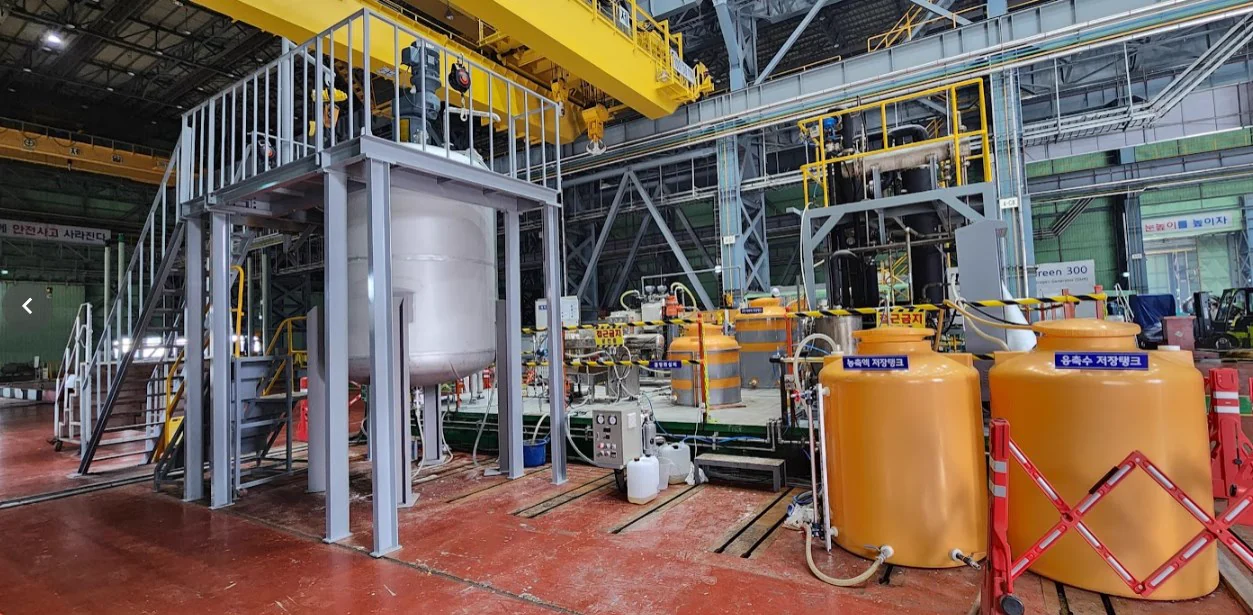
Steel slag is milled and prepared as a slurry. Free CaO and Ca(OH)₂ leach into solution and raise the pH before flue gas from a sinter plant, reheating furnace or captive-power unit is introduced. Ca²⁺ and carbonate ions precipitate as CaCO₃, permanently binding the CO₂ in the solid. The carbonated product can become stabilised aggregate, blocks or other construction material, while carbonation reduces free-lime expansion.
Calcium in silicate phases leaches more slowly, so the leaching rate, liquid-to-solid ratio and residence time are design variables. The route is relevant to CCTS compliance for the notified iron and steel sector, subject to project-specific verification.
It also addresses current and legacy slag utilisation liabilities, including land occupation and leaching concerns, while creating a potential revenue route through local infrastructure demand for aggregate and blocks. Verified emissions intensity is also commercially relevant to exporters exposed to CBAM.
Flue-gas CO₂ and fly ash to building materials.
Power stations and refineries sit beside large volumes of fly ash and vent CO₂ continuously. Combined and cured, they produce bricks and blocks that are never fired.
Source — ANYTECH Co., Ltd process documentation
Why bricks
India's brick demand is very large. Conventional clay bricks consume topsoil and are fired with coal. CO₂-cured bricks are hardened rather than fired.
Why fly ash
It is already stockpiled in volume beside the plants that generate it, at almost no cost, so transport distance stays short.
Why the equipment is simple
Mixer, press and curing chamber. No high temperature or pressure stage, which keeps both capital cost and operating cost down.
Measured output
- KCl purity
- ~95% standardUp to 99% on customer request
- Heavy metal removal
- 99.9%Reported Intertek Korea test result
- Reference stack gas
- ~20% CO₂ taken from stack gasNot a total-emissions capture rate
- Gas preparation
- Direct flue gasNo upstream CO₂ enrichment
- Commercial design capacity
- 10,000 / 20,000 t/yrCBS dust; final sizing is site-specific
- Reference plot footprint
- 45.0 × 32.5 mCommercial plant design
- Equipment
- Standard unitsNo exotic equipment
- Secondary output
- CaCO3Returned to the cement process
Figures from ANYTECH Co., Ltd process documentation.
Two ways to deploy it.
The same carbonation process runs in either configuration. The difference is whether the plant also recovers and sells the product.
Swipe to see all columns
Developed in Korea. Delivered in India.
The core CCU mineralisation technology is developed and owned by ANYTECH Co., Ltd in the Republic of Korea, jointly developed with KIER and supported by the Ministry of Trade, Industry and Energy. Anytech Hughes Climate Solutions Pvt. Ltd. combines that technology with HHCL's Indian delivery, commercial operation, O&M and regulatory interface.
Government-funded development
The CBS dust recycling process was developed with funding from Korea's Ministry of Trade, Industry and Energy.
Joint national R&D programme
CCUS technology for cement waste recovery, and the high-purity KCl process, were developed jointly with KIER, the Korea Institute of Energy Research, a government-funded research institute.
100+ environmental patents
ANYTECH holds more than 100 environmental patents, about 30 of them in cement and CO₂.
Demonstrated on site
A full-scale plant built and operated jointly with Hanil Cement and Hyundai Rotem, with high-purity KCl production verified jointly with UNID.
Commercial plant design
Full-scale facility designs completed for 10,000 and 20,000 tonnes per year of CBS dust, including equipment list, layout and plot plan.
Independent feedstock analysis
Bypass dust composition analysed by X-ray fluorescence spectrometry: 30.6% chlorine, 16.8% potassium oxide, 38.5% calcium oxide.
Offtake agreement
Business agreement with UNID for commercialisation of the high-purity KCl produced by the process. UNID leads the global potassium-chemicals market and imports all of its KCl feedstock.
Tell us what your plant produces.
Send us your CBS dust, fly ash or steel slag composition and your stack gas analysis. We will scope the laboratory reaction test needed before plant sizing.