
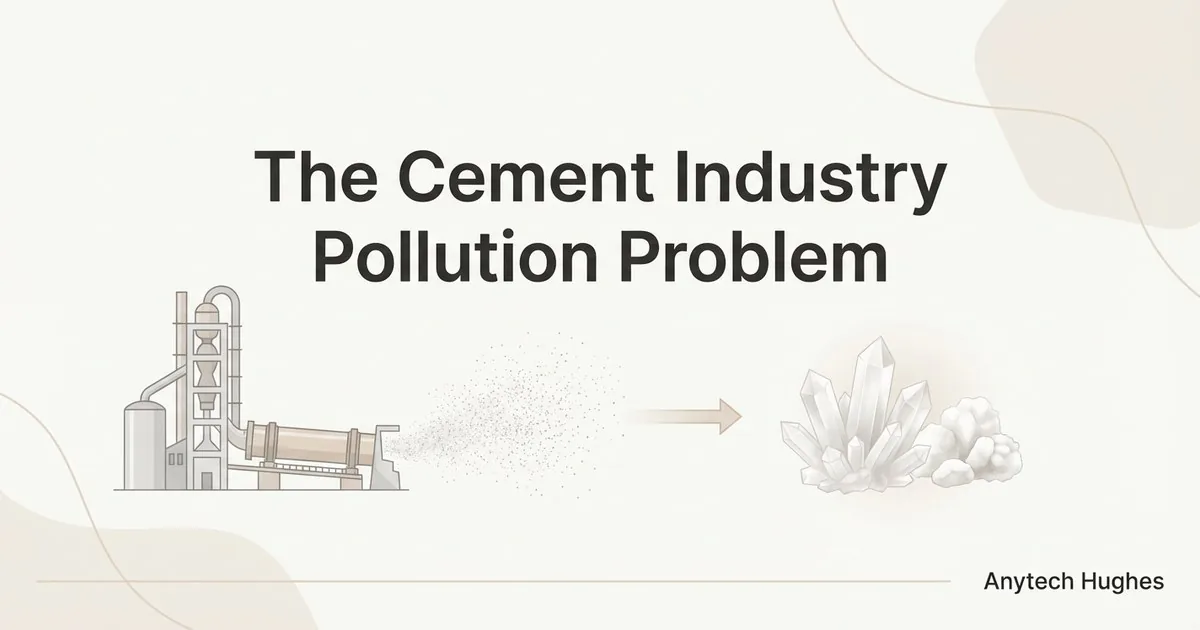
Cement is one of the most carbon- and waste-intensive industries on the planet. The sector accounts for roughly 7–8% of global CO₂ emissions, and India — the world's second-largest cement producer after China — sits at the centre of that footprint. Beyond CO₂, every operating cement plant generates large volumes of bypass dust (CBD or CKD), an alkali- and chloride-rich byproduct that has historically been one of the industry's most awkward waste streams: too contaminated to recycle back into the kiln, too voluminous and reactive to dispose of cheaply, and increasingly under regulatory scrutiny.
The Scale of the Problem
A single mid-sized cement plant typically produces tens of thousands of tonnes of bypass dust per year, and large integrated plants generate substantially more. The dust is removed from the kiln circuit specifically because chlorides and alkalis would otherwise build up to levels that disrupt clinker chemistry, damage refractories, and reduce the quality of the final cement. The bypass loop is therefore not optional — it's how modern dry-process kilns stay operational, especially when they're using alternative fuels and raw materials that introduce more chlorine into the system. The same chemistry that makes the bypass loop necessary makes the resulting dust hard to handle: it's hygroscopic, alkaline enough to require careful containment, and chemically too rich in soluble salts to blend back into clinker or even be used as a cement additive in significant volumes.
Why Disposal Isn't a Solution
Landfilling bypass dust is increasingly untenable on three fronts. First, cost: landfill fees, transport, monitoring, and lined-cell construction all keep rising as state pollution control boards tighten standards. Second, environmental risk: the chlorides and alkalis in CKD are highly soluble, which means rainwater leachate can carry them into groundwater unless containment is engineered to a high standard — and any containment failure becomes both a cleanup liability and a regulatory event. Third, reputation: investor ESG scoring, lender sustainability covenants, and customer procurement standards now look at waste-to-landfill ratios as a leading indicator of how a producer is positioned for the next decade. Cement plants that quietly landfill their bypass dust today are increasingly finding it surfaces in due diligence tomorrow.
From Waste to Resource
CCU & CCS — Chlorine Bypass System — technology takes the same dust stream and processes it into high-purity Potassium Chloride (KCl), a globally traded commodity. The process leaches the soluble alkali chlorides out of the dust, separates and crystallises the KCl, and returns a cleaner residue suitable for reintegration into the cement process. KCl itself is a critical input for fertilizer manufacturing — India imports the vast majority of its KCl requirement (called MOP, Muriate of Potash, in fertilizer markets) from a small group of mining nations, making domestic supply both economically and strategically valuable. By recovering KCl on-site, a CCU & CCS-equipped cement plant turns a regulated cost line into a measurable revenue stream, simultaneously reducing landfill liability and creating a domestic alternative to imported potash. Learn more in What is a Chlorine Bypass System and Converting Bypass Dust into KCl.
What This Means for the Industry
For cement producers, CCU & CCS isn't framed as an environmental upgrade so much as an industrial one with environmental upside. Plants that adopt waste-to-value technology shift their bypass dust line from cost-and-liability to revenue-and-asset. They strengthen their position with regulators ahead of the next round of environmental tightening. They improve the metrics that increasingly drive lender and investor decisions — waste circularity, scope-3 mineral imports, water and effluent — without compromising on production. And they position themselves favourably as sustainability becomes a procurement criterion in infrastructure tenders, where the carbon and waste profile of supplied cement is starting to be specified explicitly.
The Regulatory Trajectory
The direction of regulation is unambiguous. India's CPCB has progressively tightened standards on industrial dust handling and hazardous-waste classification, and state-level enforcement is becoming more active. Internationally, the EU's Carbon Border Adjustment Mechanism (CBAM) is in transitional reporting phase and will fully apply to cement imports from 2026, meaning Indian cement exporters to the EU will face carbon-cost adjustments tied to the embedded emissions of their product. Reducing the waste and energy footprint of the cement process — including how byproducts like bypass dust are handled — directly affects competitiveness in those markets. Plants that invest in circular processes now are buying optionality for a future where the cost of not doing so is priced in.
What CCU & CCS Adoption Looks Like in Practice
A CCU & CCS deployment is a capex commitment with a defined payback profile. The economics are driven by three variables: the volume of bypass dust produced, the prevailing market price of KCl/MOP, and the avoided cost of landfilling and compliance. For larger integrated plants with significant bypass volumes, the combined revenue plus cost-avoidance can deliver payback periods well within standard industrial investment horizons. Smaller plants typically evaluate it as part of a broader sustainability or expansion programme. The technology integrates into the existing kiln circuit without disrupting clinker production, which is the operational requirement that makes adoption realistic. The harder work is usually commercial — securing offtake for the recovered KCl and integrating the new revenue stream into plant accounting — and that's where the partnership model around CCU & CCS deployment matters most. Explore Carbon Capture for the process details.
Related Articles
What is a Chlorine Bypass System (CCU & CCS) in Cement Plants?
A technical introduction to Chlorine Bypass Systems: why cement kilns need them, how they work, and how they turn a hazardous waste stream into value.
Read moreConverting Cement Bypass Dust into Potassium Chloride (KCl)
The chemistry, process steps, and economics behind turning cement bypass dust into high-purity potassium chloride.
Read moreCircular Economy in the Cement Industry: Turning Waste into Value
How circular economy principles apply to cement manufacturing — and how CCU & CCS technology turns waste streams into revenue streams.
Read moreWant to discuss your specific requirements?
Our team can help assess and tailor a solution for your organization.
Explore Carbon Capture